
When an organ donation is authorized, a family has decided on one of the worst days of their lives to honor the donor’s wishes and make it the best day for a transplant recipient. It also begins a complex, precise and lifesaving process, part of which begins long before a transplant ever takes place.
In Illinois and Indiana that process starts in the Gift of Hope Organ & Tissue Donor Network Laboratory, where science, speed, and compassion come together to turn generosity into a second chance at life.
“The Gift of Hope lab may operate behind the scenes, but our work is essential to every successful transplant,” said Dr. Sam Ho, Laboratory Director at Gift of Hope.
Where the Matching Process Starts
Every potential organ donor begins their journey in the laboratory with blood typing. This is the first critical step in ensuring compatibility between donors and potential recipients. From there, donor samples undergo extensive infectious disease testing to protect recipients and ensure the safety of every transplant.
“All potential donors are tested for the presence of pathogens in their system,” Dr. Ho says. “That includes bacteria, viruses and parasites.”
Advanced laboratory instruments allow scientists to detect viruses at the DNA level, delivering highly sensitive results when time matters most.
Readiness at Any Moment
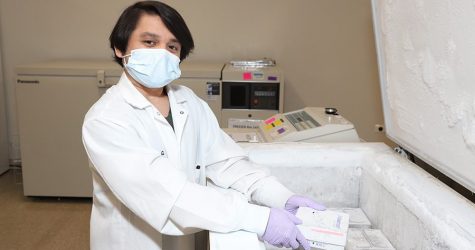
One of the lab’s unique responsibilities is maintaining a massive biorepository of frozen recipient samples. Inside carefully monitored freezers are blood samples from thousands of patients waiting for organ transplants across Illinois.
“If someone is waitlisted for an organ transplant anywhere in Illinois, we should have a sample in our freezer,” Dr. Ho says.
Samples arrive monthly and are preserved so that when an organ becomes available, whether tomorrow or years from now, the lab can act immediately.
“Some of these patients have waited five years, six years, or more,” Ho adds. “When that offer finally comes, we want the process to flow smoothly.”
A “Mini Transplant”
One of the most critical steps in the matching process happens during crossmatching, which Dr. Ho often describes as a “mini transplant experiment.” A successful crossmatch significantly reduces the risk of organ rejection after transplant.
In this test, donor cells are mixed with recipient blood samples in a controlled laboratory setting.
“We put donor material and donor cells together with the recipient blood sample in a test tube,” Dr. Ho explains. “What we’re looking for is the lack of a reaction, proof that there’s nothing in the recipient that would target or attack the donor organ. That way, when the transplant happens, there are no last-minute surprises. Everything is ready to go.”
The People Behind the Process
The Gift of Hope Laboratory is staffed by approximately 35 highly trained clinical laboratory scientists who work around the clock, even on holidays! Each team member undergoes three to six months of specialized training and is cross-trained across testing areas, not the case in most hospital-based laboratories.
Behind the scenes, in a laboratory most people never see, Gift of Hope scientists work to make sure that gift is delivered safely, accurately, and with care.
Where Hope Becomes Possible
At any given moment, the Gift of Hope Laboratory stands at the powerful crossroad between donor families experiencing loss and recipients receiving the call that could change their lives.
“On one side, you have a donor family grieving,” Dr. Ho says. “On the other side, a recipient who’s excited, nervous and scared. We’re in the middle, making sure those two match.”
To learn more about organ and tissue donation, visit giftofhope.org.